Choosing the right night vision technology can be daunting. With options like infrared and laser, it's essential to make an informed decision. Renowned night vision expert Dr. Sarah Edwards states, "Understanding the differences in technology is key to optimal performance and safety."
When considering how to choose between infrared and laser night vision, several factors come into play. The environment matters greatly. For example, infrared technology excels in total darkness and dense foliage. It offers clear images in low-light scenarios. However, laser night vision can provide superior clarity over distance and in varying conditions.
Practical use cases further illustrate their distinctions. For hunting, many prefer infrared for stealth and minimal detection risk. In contrast, professionals in security may lean towards laser due to its precision. Personal experiences often reveal that what works for one may not suit another. Ultimately, the choice between infrared and laser night vision may not be straightforward. Users should reflect on their needs before making a decision.
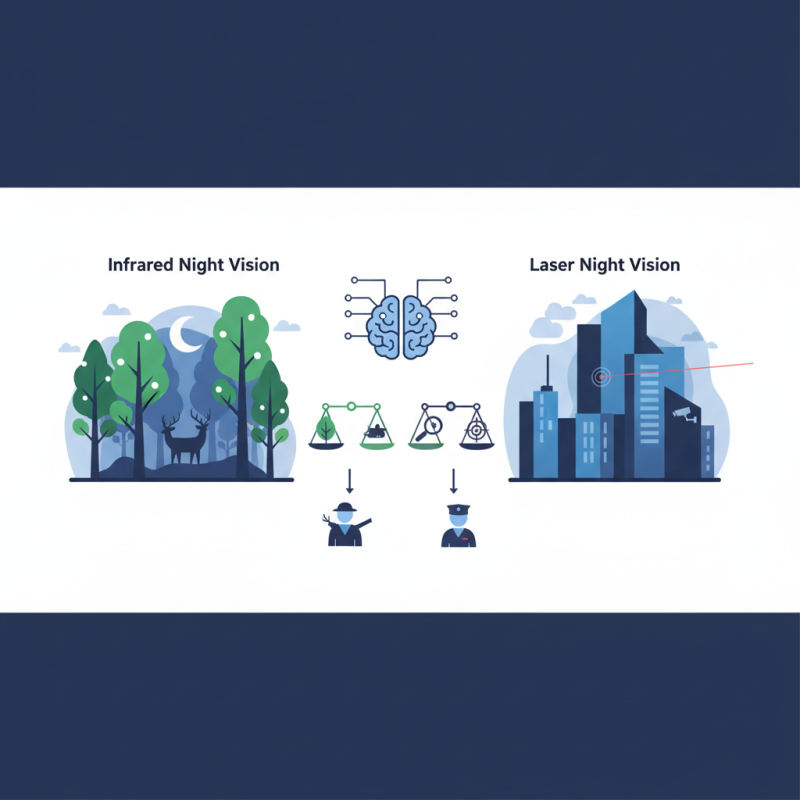
Infrared and laser night vision technologies serve different purposes but both offer unique advantages. Infrared night vision typically operates by detecting heat emitted by objects. According to a report by the Night Vision Task Force, around 60% of law enforcement agencies prefer infrared due to its efficiency in low-light conditions. It uses available light, often making it sensitive to ambient conditions. This reliance on thermal signatures means users can see in total darkness, yet they may encounter challenges in bright environments.
On the other hand, laser night vision employs coherent light. This technology can provide extraordinary clarity and range. Military studies show that laser systems can enhance target acquisition by over 40%. However, they are not as effective in dense foliage or under rainy conditions. Users might find that while clearer, laser night vision can suffer from overexposure or blinding reflections. Balancing image quality and environmental adaptability is crucial for optimal performance.
Choosing between these technologies involves understanding specific needs. Consider factors like target distance, environmental conditions, and the type of activity. Both technologies have strengths and weaknesses. A thorough assessment can lead to better decision-making in selecting suitable night vision systems.
| Feature | Infrared Night Vision | Laser Night Vision |
|---|---|---|
| Image Quality | Good visibility in low light | High clarity with enhanced detail |
| Range | Limited range; ideal for short distances | Extended range; effective over long distances |
| Power Consumption | Generally lower, prolonging battery life | Higher, which may reduce battery duration |
| Cost | More affordable technology | Typically higher due to advanced features |
| Weather Performance | Effective in fog and rain | Performance may vary; less effective in adverse weather |
| Application | Common in surveillance and wildlife observation | Used in military and tactical operations |
| User-Friendliness | Easier for beginners to use | May require training for optimal use |
| Weight | Usually lighter | Often heavier due to the technology |
| Field of View | Narrower field of view | Wider field of view for better situational awareness |
| Heat Detection | Detects heat signatures effectively | Limited heat detection capabilities |
: Infrared night vision excels in low-light areas like dense forests and abandoned buildings. It detects heat signatures effectively.
Consider your needs. Determine if you require longer distances or broad visibility. Test devices in various settings.
Laser night vision provides better precision and clarity. It enhances target acquisition in low-light conditions.
Infrared night vision works well in fog and rain. It remains reliable where other technologies may fail.
Assess the intended use, environmental conditions, and battery life. Ensure comfort and usability for extended periods.
Thermal sensitivity affects performance in cold temperatures. Some systems may struggle, which can impact their effectiveness.
Testing equipment beforehand uncovers hidden limitations. You gain confidence in your decision with hands-on experience.
Users may overlook key features like thermal sensitivity. Always consider environmental effects on device performance.
Weight matters for comfort, especially during long use. But don't ignore battery life and specific features you need.
Yes, it allows for undisturbed observation of animals in dark settings. This benefits wildlife enthusiasts significantly.
When considering how to choose between infrared and laser night vision, it's essential to understand the key differences between these two technologies. Infrared night vision excels in low-light environments, providing clear images without requiring visible light, making it ideal for most general outdoor and tactical situations. On the other hand, laser night vision offers precision and enhanced range, which is beneficial for specific applications such as surveillance or targeting.
In selecting the appropriate night vision technology, users should evaluate their unique needs and the environments in which they will operate. Important factors include performance, environmental adaptability, and cost-effectiveness. Balancing these elements with your intended use can facilitate an informed decision, ensuring that the night vision equipment you choose aligns with your performance expectations and budget.

 HawkEye Camera