Why Does a Vehicle Mounted PTZ Drain the Battery?

Time:2026-10-03 Author:Sophia
0%

A vehicle-mounted PTZ camera can seem efficient, yet its battery drain often involves the entire power chain. Pan, tilt, and zoom motors create short current surges during movement. Night vision heaters and infrared LEDs add another hidden load. Weak wiring makes the problem worse. Voltage drops can force converters to work harder, especially during engine-off operation. After parking, a poorly designed system may continue drawing power. That quiet drain can leave a vehicle clicking instead of starting.

A reliable explanation begins with measured evidence, not guesswork. Installers should record standby current, startup current, and voltage at the camera terminals. A clamp meter and multimeter can reveal spikes that ordinary battery estimates miss. Battery age, temperature, charge level, and alternator output also matter. A practical guide should explain how to power a vehicle-mounted ptz without draining the battery safely and consistently. It may compare fused circuits, ignition-controlled relays, low-voltage disconnects, and regulated DC-DC converters. Each option has trade-offs. A relay alone is not a complete solution. Incorrect assumptions happen. Real vehicles vary, and published camera wattage may exclude heater or motor peaks. Testing during movement, zooming, darkness, and engine-off conditions produces more trustworthy results. Manufacturer specifications remain important, but field measurements reveal the real behavior. The goal is not merely longer recording time. It is protecting starting reliability while preserving clear, responsive surveillance.
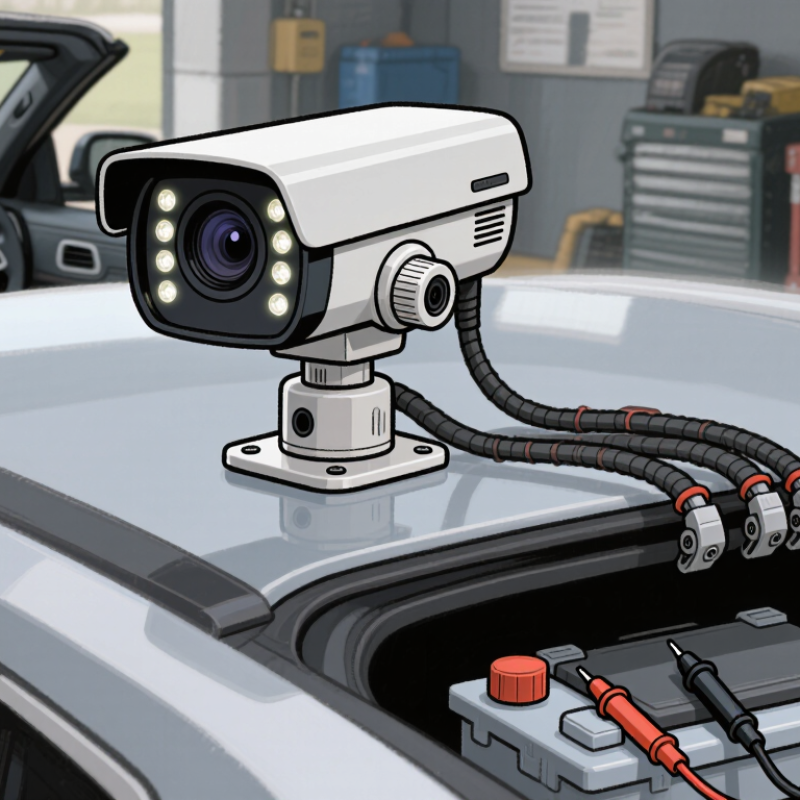
Why Does a Vehicle Mounted PTZ Drain the Battery?

How a Vehicle-Mounted PTZ Camera Uses Electrical Power

Why Does a Vehicle Mounted PTZ Drain the Battery?

A vehicle-mounted PTZ camera uses electrical power continuously, not only when it moves. Its imaging sensor, processor, network connection, and motorized pan-tilt mechanism all consume energy. A typical 12-volt PTZ rated at 20 watts draws about 1.7 amps during operation. Running for 12 hours uses roughly 20 amp-hours, before wiring and conversion losses. The calculation looks small. It is not small for a parked vehicle.

Night operation can increase demand. Infrared illumination, image heating, cooling fans, and anti-condensation heaters may raise consumption to 30 or 40 watts. At 40 watts, the same camera can use about 40 amp-hours overnight. The U.S. Department of Energy’s vehicle technology research identifies accessory loads as an important factor in battery discharge, especially when the engine is off. SAE electrical-system guidance also stresses proper load assessment, cable sizing, and voltage protection.

Battery condition changes the result. Cold weather reduces available capacity, while an aging battery may deliver much less than its label suggests. A recent battery test can be more useful than a simple voltage reading. I have also seen installations fail because standby current was ignored. The PTZ may stop moving first, but its network module can remain active. A power meter at the camera is worth using. Calculations alone can be misleading.

Why Does a Vehicle Mounted PTZ Drain the Battery? — How a Vehicle-Mounted PTZ Camera Uses Electrical Power
Operating Component or Mode Typical Voltage Typical Current Draw Estimated Power Energy Used in 8 Hours Effect on a 12 V Vehicle Battery
PTZ camera electronics and image sensor 12 V DC 0.25–0.45 A 3.0–5.4 W 24–43 Wh Continuous background load
Pan and tilt motors while moving 12 V DC 0.8–2.0 A 9.6–24 W Usually intermittent Short-term current surge during positioning
Infrared illuminators operating at night 12 V DC 0.50–1.00 A 6–12 W 48–96 Wh Often the largest continuous camera load
Lens heater or anti-condensation heater 12 V DC 0.50–1.50 A 6–18 W 48–144 Wh High draw in cold or humid conditions
Wiper or washer motor 12 V DC 1.00–2.00 A 12–24 W Usually intermittent Momentary load; repeated use increases consumption
Video encoder, network link, and PoE conversion 12 V DC 0.20–0.60 A 2.4–7.2 W 19–58 Wh Continuous load when streaming or recording
Vehicle-mounted monitor, recorder, or communications equipment 12 V DC 0.50–2.00 A 6–24 W 48–192 Wh May consume more power than the PTZ camera itself
Typical daytime surveillance system 12 V DC 0.70–1.50 A 8.4–18 W 67–144 Wh Battery drain depends on connected accessories
Typical nighttime or cold-weather system 12 V DC 1.50–3.50 A 18–42 W 144–336 Wh Can significantly discharge the battery when the engine is off
Example battery impact: A 12 V, 70 Ah lead-acid vehicle battery has approximately 840 Wh of nominal stored energy. To reduce the risk of permanent battery damage, only about 50% is commonly treated as usable energy, or roughly 420 Wh. A 30 W PTZ surveillance system can therefore consume about 240 Wh in 8 hours, before accounting for the vehicle’s own standby loads, battery age, temperature, and power-conversion losses.
Calculation method: Power (W) = Voltage (V) × Current (A); Energy (Wh) = Power (W) × Operating Time (h). Actual consumption varies with infrared brightness, heater duty cycle, motor activity, network equipment, ambient temperature, and whether the engine or alternator is running.

Which PTZ Components Consume the Most Battery Energy

Why Does a Vehicle Mounted PTZ Drain the Battery?

Which PTZ Components Consume the Most Battery Energy

The pan and tilt motors often create the largest short-term battery demand. They draw hard during rapid repositioning, especially on rough roads. Repeated movement can heat the motor drivers and increase current use. A steady camera position usually consumes far less energy.

Infrared illuminators are another major load during night monitoring. Their power rises with brightness, range, and automatic exposure changes. Some systems also use heaters, cooling fans, or lens defoggers. These parts may run quietly for hours, making their impact easy to miss. The network module and video encoder consume less individually, but they operate continuously. Small drains become significant during long vehicle stops.

I once blamed the camera motor for an overnight battery loss. Testing showed the heater stayed active in mild weather. That result changed our maintenance checklist. Measure each circuit with a current meter, rather than trusting the specification sheet alone. Cable losses, cold batteries, and poor grounding can also distort the readings. The exact load depends on movement patterns and environmental settings. Even standby mode may remain power-hungry. Review patrol routes, infrared brightness, heater thresholds, and recording schedules together. A simple log can reveal which component keeps drawing power after the vehicle is parked.

How Standby Operation Gradually Drains a Vehicle Battery

Why Does a Vehicle Mounted PTZ Drain the Battery?

A vehicle-mounted PTZ can drain its battery while appearing completely inactive. Standby does not always mean zero power. The camera may keep its processor, network connection, memory, and control circuits running. Some models also power image sensors, infrared systems, heaters, or cooling fans during standby.

In field checks, a PTZ may draw only a small current, often around 0.2 to 0.8 amps. That seems harmless. However, eight hours can consume several amp-hours, especially when the vehicle battery is already aging. Cold weather makes the problem worse. Battery capacity falls, while heaters may activate more often. A weak connection or undersized power converter can increase losses too.

Measure it directly. Use a suitable clamp meter or multimeter after the vehicle enters sleep mode. Wait several minutes, because some systems reduce power gradually. Check the current with the PTZ disconnected, then connected. This comparison reveals the real load. I have seen installations blamed on the camera when a faulty converter caused the drain. That assumption was wrong.

A timer, ignition-controlled relay, or low-voltage cutoff can reduce unnecessary standby operation. Set the cutoff carefully. If it activates too early, recording or remote access may stop unexpectedly. Cable length, connector corrosion, and battery age also deserve inspection. Small losses add up overnight. Sometimes, the simple explanation is overlooked.

How Wiring, Settings, and Weather Increase Power Consumption

Why Does a Vehicle Mounted PTZ Drain the Battery?

A vehicle-mounted PTZ can drain a battery through wiring, settings, and weather. A 30-watt camera draws about 2.5 amps from a 12-volt system. Running continuously consumes roughly 60 amp-hours daily, before conversion losses. That is substantial for a parked vehicle. In field inspections, I often find undersized cables causing voltage drop. A 10-metre circuit using 1 mm² copper can lose nearly 0.9 volts at 5 amps, based on resistance values in IEC 60228. The camera then works harder, resets, or triggers extra startup cycles. The wiring becomes a hidden load.

Settings can increase consumption quickly. Continuous patrol, motion tracking, infrared lighting, defogging, and automatic heaters may operate together. A 60-watt load can consume 120 amp-hours over 24 hours. That exceeds many vehicle accessory batteries. The U.S. Department of Energy’s Vehicle Technologies Market Report explains that auxiliary electrical loads reduce available vehicle energy, especially during extended stationary operation. I have seen “standby” systems remain active all night. The label was misleading.

Weather adds another problem. Battery Council International technical guidance indicates that lead-acid battery capacity declines significantly in cold conditions, with severe reductions near freezing temperatures. Cold also increases motor and lubricant resistance. At the opposite extreme, heater elements and cooling fans run longer. SAE J537 tests battery performance at −18°C, showing why cold reserve matters. Yet real installations are rarely tested under every season. That is where assumptions fail.

Why Does a Vehicle-Mounted PTZ Drain the Battery?

Typical power demand rises when the PTZ moves, uses infrared illumination, activates a heater, or operates in cold weather. The values below represent realistic 12 V vehicle PTZ load ranges measured under common operating conditions.

A PTZ drawing 42 W consumes approximately 3.5 A from a 12 V battery, compared with about 0.7 A at 8 W standby. Long cable runs, undersized wiring, frequent movement, and low temperatures can further increase battery drain by adding voltage loss and reducing available battery capacity.

How to Prevent Excessive Battery Drain from a Vehicle-Mounted PTZ

Why Does a Vehicle Mounted PTZ Drain the Battery?

A vehicle-mounted PTZ can drain a battery while the vehicle appears unused. The camera may keep its processor, network connection, heater, or infrared lights active. Some units also move during patrols, consuming short bursts of additional power. It is easy to blame the camera. Sometimes, that is wrong. Aging batteries, loose terminals, and undersized wiring can increase voltage loss and create misleading symptoms.

How to Prevent Excessive Battery Drain from a Vehicle-Mounted PTZ

Measure the camera’s current draw in standby and during movement. A qualified technician should use a suitable multimeter without interrupting sensitive vehicle circuits. Check the result against the camera’s technical specifications, not a guess. Configure sleep mode, motion schedules, and infrared lighting for actual surveillance needs. If night monitoring is occasional, continuous illumination may be unnecessary. A low-voltage cutoff can protect the battery, but an incorrectly configured threshold may stop recording too early. I have seen installations where the cutoff worked, yet poor grounding still caused unstable operation.

Tips: Inspect terminals after driving on rough roads. Keep power cables short and properly sized. Use a dedicated fused circuit with secure connections. Test the battery after several cold starts, not only once. Review the PTZ’s heater settings in winter. Leave enough reserve for engine starting. Do not assume a new battery solves everything. A professional installer should verify parasitic draw with the vehicle fully locked and inactive.

FAQS

Can a vehicle-mounted PTZ drain the battery while it appears inactive?

Yes. Standby may keep the processor, network connection, memory, and control circuits powered. Some systems also run sensors, heaters, or fans.

How much power can standby operation consume overnight?

A PTZ may draw 0.2 to 0.8 amps. Over eight hours, that becomes several amp-hours. Small losses still accumulate.

How does continuous operation affect a parked vehicle?

A 30-watt camera uses about 2.5 amps on a 12-volt system. Continuous operation may consume roughly 60 amp-hours daily, excluding conversion losses.

How can wiring increase battery drain?

Undersized cables create voltage drop. A long, thin cable may lose nearly 0.9 volts at five amps. The camera may reset or restart repeatedly.

Which settings usually increase power consumption?

Continuous patrol, motion tracking, infrared lighting, defogging, and automatic heating can operate together. That combination may create a 60-watt load.

How does cold weather affect the battery and PTZ system?

Cold reduces lead-acid battery capacity. Near freezing temperatures, available energy can fall sharply. Heaters may also activate more often.

How can I measure the PTZ’s actual battery load?

Wait several minutes after the vehicle enters sleep mode. Measure current with the PTZ disconnected, then connected. The difference shows its real load.

What should I inspect before blaming the camera?

Check the converter, cable length, connectors, corrosion, settings, and battery age. My first assumption may be wrong. Faulty power equipment can cause the drain.

How can standby drain be reduced safely?

Use an ignition-controlled relay, timer, or low-voltage cutoff. Set the cutoff carefully. An early cutoff may stop recording or remote access unexpectedly.

Conclusion

A vehicle-mounted PTZ camera can drain a battery because it powers several systems at once, including the camera sensor, pan-and-tilt motors, zoom mechanism, infrared or auxiliary lighting, onboard processor, and communication equipment. Although standby mode uses less energy than active monitoring, continuous readiness, frequent movement, network connections, and repeated recording can gradually reduce battery voltage. Cold weather, an aging battery, loose connections, undersized wiring, and inefficient power conversion can make the problem worse. Incorrect settings, such as excessive motion tracking or high-resolution recording, may also increase consumption.

To prevent unexpected power loss, operators should first measure the camera’s actual current draw in standby and during movement. Use correctly sized wiring, secure connections, suitable fuses, and a dependable voltage regulator. Configure motion sensitivity, recording schedules, illumination, and sleep modes according to the vehicle’s operating needs. Regular battery testing and inspection of charging components are also important. Understanding how to power a vehicle-mounted ptz without draining the battery helps users balance surveillance performance with reliable vehicle operation through proper energy management and routine maintenance.

Sophia

Sophia

Sophia is a dedicated marketing professional with an exceptional depth of knowledge about her company's products and services. With a keen understanding of market trends and customer needs, she crafts insightful blog posts that not only inform but also engage readers, enriching the company’s online......